What is your risk of Diabetes?

In short
Your risk of Type 2 Diabetes depends on your age, family history, ethnicity and weight, and it is higher if you have PMOS (PCOS) or an HbA1c of 42 to 47 mmol/mol. You can check your risk in about 2 minutes with Diabetes UK’s free Know Your Risk tool.
Have you ever wondered what your risk of Diabetes is? If not, it might be worth thinking about it.
“Why?”…I hear you ask.
Type 2 Diabetes is becoming ever more prevalent in the Western World, with statistics showing that 1 person was diagnosed with Type 2 Diabetes every 2 minutes in the UK in 2019. (opens in a new tab)
How common is Type 2 Diabetes in the UK?
Very common: Diabetes UK estimates that over 4.7 million people in the UK have a Diabetes diagnosis, and around 90% of them have Type 2 Diabetes (Diabetes UK (opens in a new tab)).
Does that statistic shock you? It should!
In addition to that, there are thought to be almost 1.3 million more people walking around with Type 2 Diabetes that has not yet been diagnosed, and another 6.9 million whose blood sugar is high enough to put them at increased risk. This is potentially dangerous as undiagnosed, and therefore possibly uncontrolled, Diabetes can have a huge impact on your health, with complications including problems with your sight, kidneys and feet.
In order to avoid this, try to ensure that you are aware of the common symptoms of Diabetes, so that you get them checked out if necessary. If you are aged 40 to 74 and live in England, your free NHS Health Check, offered every 5 years, also checks your risk of Diabetes (NHS (opens in a new tab)).
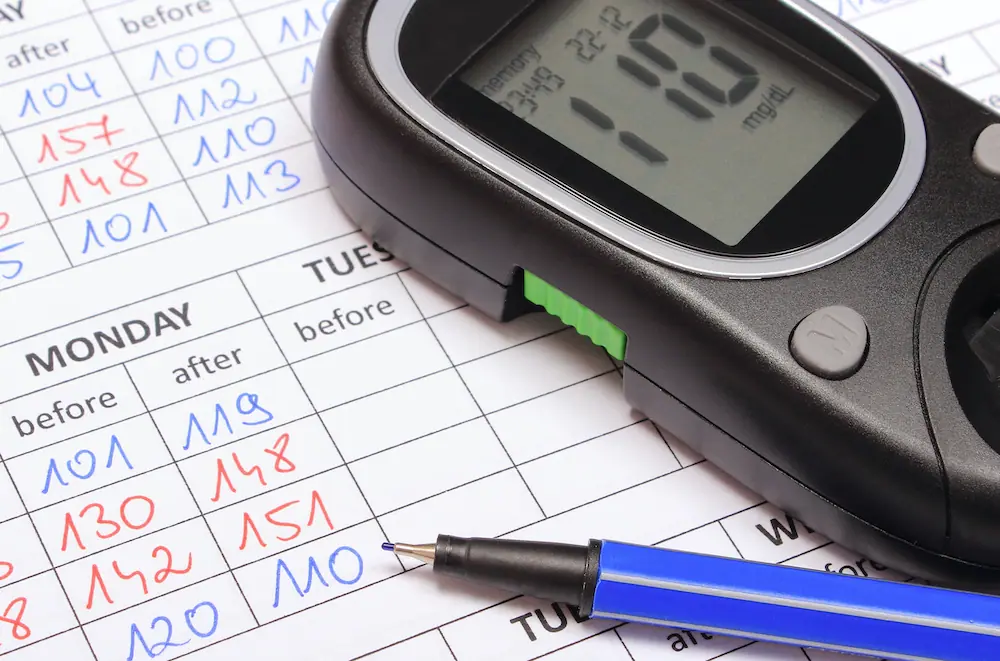
If you know you are at risk of Diabetes don’t delay – get tested!
What are the symptoms of Diabetes?
The most common symptoms of Diabetes are going to the toilet a lot, being really thirsty and feeling more tired than usual. The full list from the NHS is (NHS (opens in a new tab)):
- Going to the toilet a lot, especially at night
- Being really thirsty
- Feeling more tired than usual
- Losing weight without trying to
- Genital itching or thrush
- Cuts and wounds taking longer to heal
- Blurred vision
Ignoring symptoms will not make them go away!

If you know you are at risk of Diabetes you can choose to make lifestyle changes to decrease your risk. For five practical places to start, see my small changes that can lower your risk.
Are there other warning signs?
Yes. Even without symptoms, your risk is higher if:
- you have PMOS (PCOS), which Diabetes UK lists as a risk factor (Diabetes UK (opens in a new tab))
- you had Diabetes in pregnancy (gestational Diabetes)
- your waist is 94cm (37 inches) or more if you are a man, 90cm (35 inches) or more if you are a South Asian man, or 80cm (31.5 inches) or more if you are a woman (Diabetes UK (opens in a new tab)): I explain why your waist matters in my post on symptoms in men
- you have been told your HbA1c is 42 to 47 mmol/mol, which is the pre-Diabetes range
What if you don’t have any symptoms?
You can still have Type 2 Diabetes: not everyone with Diabetes has any symptoms and that is why knowing your risk is so important. When you know your risk you will know whether to have a blood test to check your blood glucose levels. You can then also make diet or lifestyle changes to either lower your risk or help you manage your blood glucose levels, if you do get diagnosed.
How can you check your risk of Diabetes?
The quickest way is Diabetes UK’s free ‘Know Your Risk’ quiz (opens in a new tab). To make it as easy as can be, you can also check your BMI on my website.
It will only take 2 minutes and could be the most important thing you do today!